
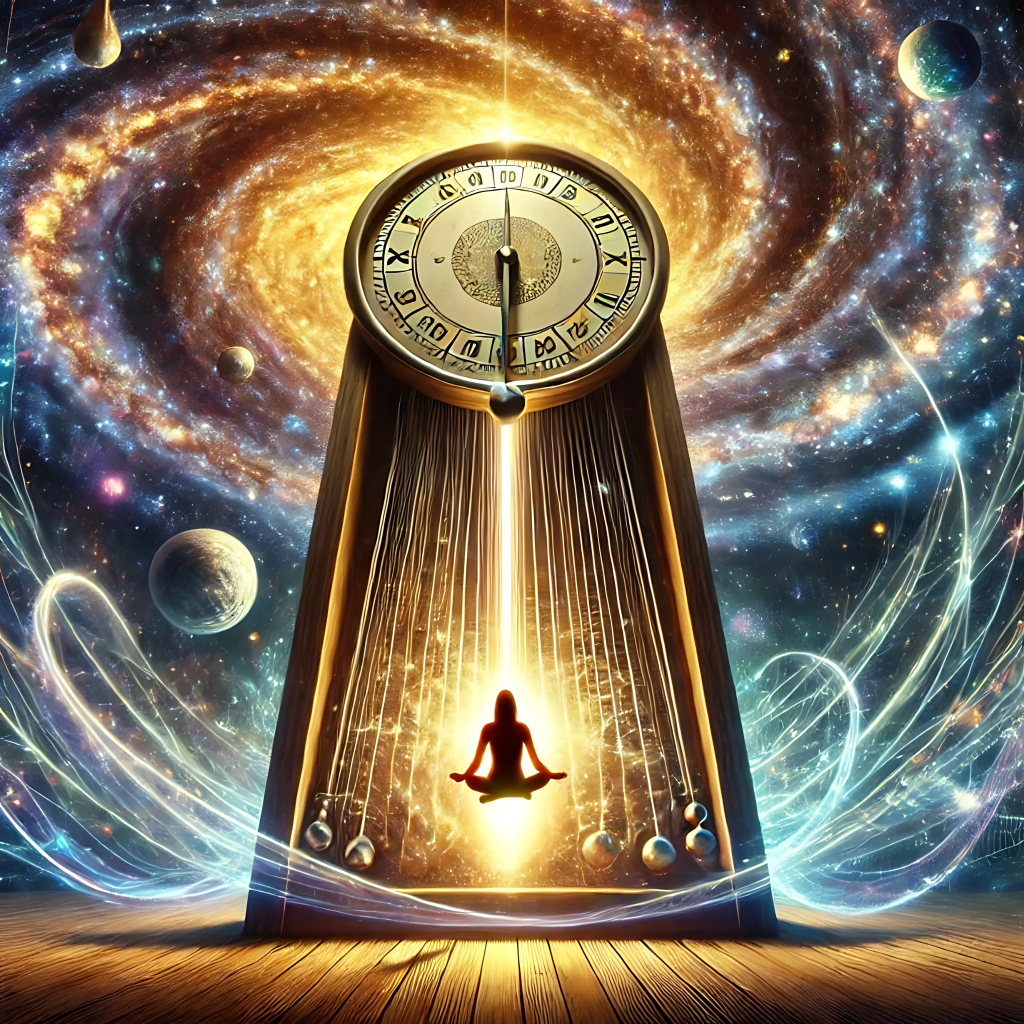
Rhythm: Life’s Cosmic Beat
We’ve explored Mentalism, Correspondence, Vibration, and Polarity, learning how reality is shaped by thought, patterns echo through all layers of existence, everything moves, and opposites are just two ends of the same stick. Now, we arrive at The Principle of Rhythm, which tells us: “Everything flows, out and in; everything has its tides; all things rise and fall.”
In short, life moves in cycles. The highs never last forever, but neither do the lows. The tide comes in, and the tide goes out. Just when you think you’ve got everything together, a cosmic breeze sweeps in and rearranges the furniture of your life. But before you shake your fist at the universe, Hermetic wisdom suggests that understanding Rhythm doesn’t just help us cope—it helps us flow.
Rhythm: The Universe’s Built-in Playlist
Rhythm isn’t just an abstract concept—it’s woven into the very fabric of time. Many ancient traditions have recognized this, mapping out cyclical patterns that influence human experience:
- The 7-Year Cycle (Astrology & Psychology): Every 7 years, major life shifts occur—changes in relationships, careers, even the way we perceive the world. Some astrologers connect this to Saturn’s transits, while psychologists link it to natural developmental stages.
- The 9-Year Cycle (Feng Shui & Numerology): Some Eastern traditions observe a 9-year energy cycle, where each phase represents a different stage of personal evolution—from new beginnings to endings and rebirth.
- The 12-Year Cycle (Jupiter’s Influence): In astrology, Jupiter’s 12-year orbit corresponds with expansion, learning, and growth. Looking back, you might notice that major shifts in your life happened roughly a decade apart.
- The 60-Year Chinese Zodiac Cycle: Traditional Chinese metaphysics follows a 60-year cycle, based on the combination of 12 zodiac signs and 5 elements, each influencing personality, fate, and social change. I think we can skip this one, though—who has the patience to track a 60-year rhythm? If you’re determined, let me know in 2085 how it worked out for you.
- The Great Year (Plato’s 26,000-Year Cycle): Ancient cultures like the Mayans and Vedic astrologers recognized a vast cycle of 26,000 years, during which human consciousness and civilization evolve through different spiritual awakenings and material declines. Let’s give some gratitude to Plato! But if you’re reading this, by the time a new cycle comes around, you’re either in another life, completely forgetting what I’m blabbering about here, or supervising from the other side with a knowing smile.
These cycles aren’t rigid, but they do hint that life’s rhythm isn’t random—it moves through structured patterns of change. The more we recognize them, the more we can anticipate, adapt, and align ourselves with the flow instead of feeling like we’re constantly being knocked off course.
Think of Rhythm as the beat behind everything—a cosmic metronome keeping time in every aspect of existence. You’ll find it everywhere:
- Nature’s Cycles: Day and night, seasons, lunar phases, migrations, growth and decay—nature doesn’t rush, but it also doesn’t stop.
- Emotional Waves: One day, you feel unstoppable. The next? You can barely peel yourself off the couch. You’re not broken. You’re just in a different part of the cycle.
- Societal Trends: Fashion trends, economic booms and recessions, even the rise and fall of empires—history itself swings like a pendulum.
- Personal Energy: Ever notice how some weeks you’re hyper-productive, and others, just answering emails feels like an Olympic event? That’s Rhythm at work.
If everything moves to a rhythm, wouldn’t it make more sense to dance with it instead of resisting the beat?
The Pendulum Effect: Why Highs and Lows Are Inevitable
One key aspect of Rhythm is the Pendulum Swing—where everything that rises must eventually fall, and vice versa. If you’ve ever felt like life yo-yos between extremes, congratulations, you’ve met this principle firsthand.
- Extreme Productivity → Burnout
- Excitement About a New Project → Crushing Self-Doubt
- Periods of Deep Spiritual Insight → Feeling Completely Lost (which, honestly, is just my default setting at this point)
- You Being the Funniest Person at a Party → You Cringing About It Three Days Later
The pendulum always swings. The trick isn’t to stop it (you can’t), but to understand where you are in the cycle so you can move with it instead of fighting it. This is where things get interesting.
How to Work With Rhythm (Instead of Getting Dragged by It)
1. Know Where You Are in the Cycle
- Feeling on top of the world? Don’t get cocky—prepare for the inevitable dip, but don’t fear it either.
- Feeling stuck in a slump? It won’t last. Nothing does. Trust that the upswing will come.
- Life isn’t about stopping the waves; it’s about learning how to surf.
2. Use the Downswing for Reflection, Not Panic
- When energy is low, instead of forcing productivity, lean into rest, learning, and introspection. Even trees lose their leaves before blooming again.
- Trying to push during a natural low period can backfire. It’s like running against an escalator—exhausting and unnecessary.
3. Anchor Yourself in What’s Constant
- While external rhythms shift, having core practices (meditation, journaling, physical movement, creative outlets) helps you stay steady when life feels chaotic.
- The ocean has tides, but the deep waters remain calm. Your goal? Tap into that part of yourself.
4. Accept That Setbacks Are Often Setups
- Sometimes, a “backward” swing isn’t a regression—it’s a course correction. The universe isn’t punishing you; it’s just redirecting you. Big difference.
- Perspective shift: What if your lows were actually building momentum for your next rise?
Rhythm and Mastery: The Power of Anticipation
If you study anything long enough—music, martial arts, investing, or even relationships—you start to see the patterns. Winners aren’t the ones who avoid the cycles; they’re the ones who anticipate and move with them.
- A skilled surfer doesn’t fight the wave—they time it.
- A great investor doesn’t panic in a market crash—they know downturns are part of the game.
- A seasoned artist doesn’t quit when inspiration dips—they trust it’ll return.
Mastery isn’t about controlling Rhythm—it’s about understanding its flow so you can position yourself accordingly.
Finding Your Groove in the Cosmic Dance
The Principle of Rhythm teaches that life isn’t a straight line—it’s a series of waves, swings, and cycles. The goal isn’t to stop the pendulum; it’s to move with awareness.
So next time you feel like life is swinging too fast or pulling you too low, take a breath. The rhythm is still playing. You just have to find your beat.
Up Next: The Principle of Cause and Effect—because while everything moves in cycles, your actions still have weight. Get ready to explore how we shape our own reality, one choice at a time.


Leave a Reply